Grammar
Common English Mistakes Arabic Speakers Make, With Easy Examples
By TypoGrammar Editorial Team on May 14, 2026
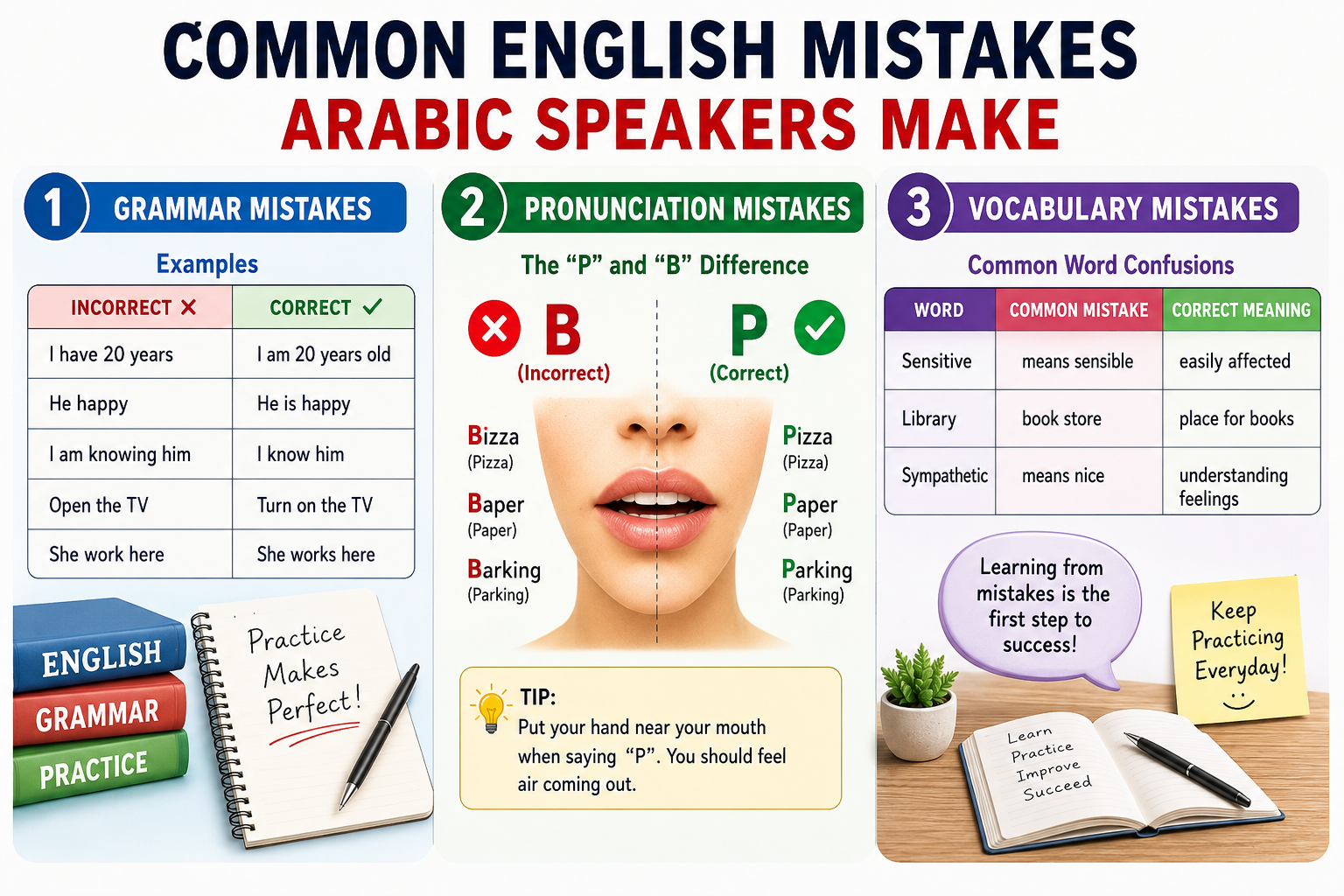
Quick Answer
The most common English mistakes Arabic speakers make include overusing "the", missing "a"/"an", dropping the verb "to be", confusing he/she, pronouncing P like B, and translating expressions like "open the TV" directly from Arabic. All of these are fixable with simple rules and daily practice.
Learning English can be difficult for Arabic speakers because Arabic and English are very different languages. Many learners make the same grammar, pronunciation, and vocabulary mistakes. The good news is that these mistakes are normal and easy to fix with practice.
In this guide, you will learn the most common English mistakes Arabic speakers make, along with simple explanations and examples.
1. Using "the" Too Much
Many Arabic speakers use "the" before every noun because Arabic uses "ال" very often.
| Incorrect | Correct |
|---|---|
| The life is beautiful | Life is beautiful |
| The people are friendly | People are friendly |
| I like the football | I like football |
Why this happens: In Arabic, nouns often need "ال". In English, general ideas usually do not use "the".
Tip
2. Missing "a" and "an"
Arabic does not have articles like "a" or "an", so learners often forget them.
| Incorrect | Correct |
|---|---|
| I bought car | I bought a car |
| She is engineer | She is an engineer |
| He has big house | He has a big house |
Simple Rule
a teachera university(sounds like "you")an applean hour(silent "h")
3. Confusing "He" and "She"
This is a very common mistake, especially in speaking.
| Incorrect | Correct |
|---|---|
| My sister, he is smart | My sister, she is smart |
| My father, she works here | My father, he works here |
Why it happens: Arabic pronouns work differently, and learners sometimes translate directly from Arabic.
Tip
- He = رجل / man
- She = امرأة / woman
4. Using Present Continuous Incorrectly
Arabic speakers sometimes say:
| Incorrect | Correct |
|---|---|
| I am knowing him | I know him |
| She is understanding | She understands |
| We are liking pizza | We like pizza |
Some verbs (called stative verbs) are not normally used with -ing. These include:
- know
- understand
- believe
- like
- love
5. Problems With Verb "To Be"
Arabic sentences often do not use is, am, or are in the present tense.
| Incorrect | Correct |
|---|---|
| He happy | He is happy |
| I tired | I am tired |
| They students | They are students |
Quick Reminder
6. Pronouncing "P" Like "B"
Arabic does not have the "P" sound in many dialects.
| Incorrect Pronunciation | Correct Pronunciation |
|---|---|
| Bizza | Pizza |
| Baper | Paper |
| Barking | Parking |
Practice words:
peopleproblempencilpassport
Tip
7. Using "Open" and "Close" Incorrectly
Arabic speakers sometimes translate expressions directly.
| Incorrect | Correct |
|---|---|
| Open the TV | Turn on the TV |
| Close the light | Turn off the light |
Correct expressions:
Turn on the lightTurn off the computerOpen the doorClose the window
8. Confusing "Do" and "Make"
This is one of the most common vocabulary mistakes.
| Use "Do" | Use "Make" |
|---|---|
| do homework | make food |
| do work | make coffee |
| do exercise | make money |
Example sentences:
I need to do my homework.My mother makes delicious cake.
9. Saying "I Have 20 Years"
Arabic speakers often translate directly from Arabic.
| Incorrect | Correct |
|---|---|
| I have 20 years | I am 20 years old |
| She has 15 years | She is 15 years old |
Correct Structure
10. Word Order Mistakes
Arabic sentence structure can be flexible, but English word order is very important.
| Incorrect | Correct |
|---|---|
| Very I like football | I like football very much |
| Always he comes late | He always comes late |
Basic English Order
Ahmed eats pizza.Sarah studies English.
11. Using "Since" and "For" Incorrectly
| Incorrect | Correct |
|---|---|
| I live here since 2 years | I have lived here for 2 years |
| She works here since Monday | She has worked here since Monday |
Easy Rule
Since = starting point (a specific moment).
for 3 yearsfor 10 minutessince 2020since Monday
12. False Friends Between Arabic and English
Some English words look easy but have different meanings.
| Word | Common Mistake | Correct Meaning |
|---|---|---|
| Sensitive | means sensible | easily affected emotionally |
| Library | confused with bookstore | place for borrowing books |
| Sympathetic | confused with nice | understanding others' feelings |
You can also read our guide on false friends in English words for more tricky vocabulary.
Most Common Grammar Problems Summary
| Problem | Example Mistake | Correct Form |
|---|---|---|
| Missing articles | I bought car | I bought a car |
| Missing "to be" | He tired | He is tired |
| Wrong pronouns | My mother, he works | My mother, she works |
| Wrong verb form | I am knowing | I know |
| Wrong word order | Always he late | He is always late |
How Arabic Speakers Can Improve Faster
1. Think in English
Do not translate every sentence from Arabic. Start with short, simple English thoughts.
2. Read Simple English Daily
Read short stories, blog posts, and news for beginners. Just 10 minutes a day adds up fast.
3. Listen to Native Speakers
Watch YouTube videos, podcasts, and interviews. See our list of the best English teachers on YouTube.
4. Practice Speaking Every Day
Even 10 minutes daily helps a lot. Talk to yourself, record voice notes, or use language exchange apps.
5. Learn Common Patterns
Instead of learning single words, learn full expressions:
How are you?Nice to meet you.I'm looking forward to it.
Recommended Reading
Frequently Asked Questions
Why do Arabic speakers struggle with English articles?
Because Arabic grammar uses articles differently from English, especially "the". Arabic nouns often need "ال", while English uses "the" only for specific, identifiable things.
What is the hardest English sound for Arabic speakers?
Many learners struggle with P, V, and CH because these sounds do not exist in some Arabic dialects.
How can Arabic speakers improve English pronunciation?
Listening daily, repeating native speakers, and practicing minimal pairs (P/B, V/F) can help a lot.
Is translating from Arabic a bad habit?
Yes. Direct translation often creates grammar mistakes and unnatural sentences.
How long does it take to improve English fluency?
With daily practice, many learners see improvement within a few months.
Final Thoughts
Making mistakes is a normal part of learning English. Most Arabic speakers struggle with the same grammar and pronunciation problems at the beginning. The key is practice, consistency, and learning from your mistakes.
Focus on small improvements every day, and your English will become much more natural over time.
Quick Check Before You Go
A 3-question recap on “Common English Mistakes Arabic Speakers Make, With Easy E…”
What is the most effective way to retain what you just read?